The “Kanc,” as it is known to locals, refers to the Kancamagus Highway, a 34.5 mile stretch of highway across the White Mountains from Conway to Lincoln, N.H. I am due to bike on this stretch tomorrow, which climbs quite dramatically to close to 3,000 feet. The Presidential Range of the White Mountains lies directly north of the route and is dominated by Mount Washington, which, at 6,288 feet, is the highest peak in the northeastern U.S.
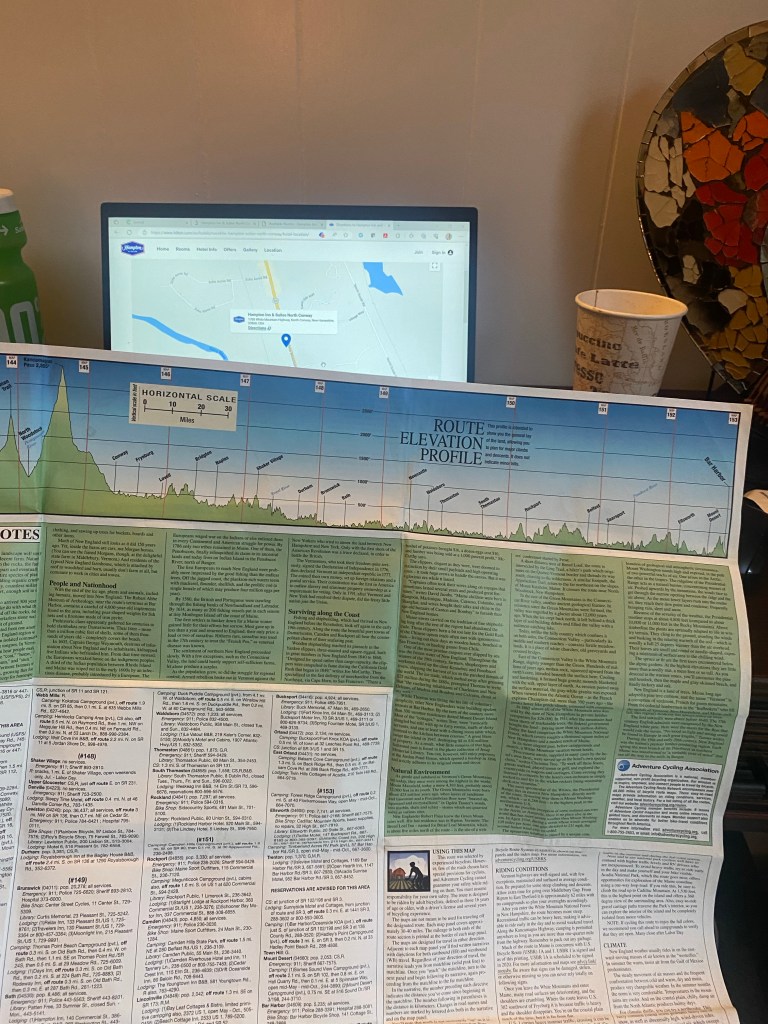
I have been intimidated by this part of my route for the past couple of weeks, after noticing the very dramatic elevation gain that leads up to Kancamagus Pass. Depicted below is the elevation map of my route so far, with my starting point, Bar Harbor, on the right side, and Kancamagus Pass on the left. As you know, I’ve been whining about hills for the past 10 days, but as you can see, they are mere anthills compared to the spike at the top of this pass. This spike looks like the EKG for a person undergoing a pretty serious cardiac event.
I was becoming more and more concerned with this part of the route, especially as bad weather was looming late last week. Can I do this? Would I be smarter to hire some kid with a pickup truck to drive my bike and me over the pass? This would be safer, for sure, and less nerve-racking and physically taxing. But then would I really be riding a bike across the United States? And would this be a slippery slope that gives me license to take the easy way out every time some new challenge comes my way, like locusts, an earthquake, or watermelon-size hail? In the end, I decided to take the advice of Alfred, Lord Tennyson, who wrote “It’s better to have tried and failed than to live life wondering what would have happened if I tried.” I’ll let you know how things turn out.
You may wonder about the unusual name of this highway. I learned that in 1957, the road was officially named Kancamagus, after a Pennacook Indian chief in the late 17th century. Apparently some New Hampshire legislators objected to the name because the chief had partcipated in the murder of an English settler, Major Richard Waldron of Dover. At the time, Representative Robert Monahan of Hanover defended Kancamagus as a decent man who was provoked to war by an act of treachery perpetrated by Waldron that had resulted in the death of a number of the tribe’s leaders. Monahan added, “I’ll admit that the name may be a bit difficult, but it’s easier to spell than Winnipesaukee and easier to pronounce that Chocorua.”
In reading further about this next section of the route, I learned that there is no place in the world with more severe weather than the area around Mount Washington, outside of some isolated areas of the Arctic and Antarctica. In April 1934, during a storm there, the second strongest gust ever recorded clocked a wind speed of 214 mph. Apparently, Mount Washington stands in the path of two competing air streams, one from the Arctic and one from the tropics, and this results in extremely severe storms. As a result of these storms, the treeline of the Presidential Range stops at about 4,800 feet as opposed to 10,000 or 11,000 feet in the Rocky Mountains. Given the recent storm activity in the area, I have been watching weather conditions for the route carefully, since they are known to change quickly, but it appears that conditions are stable and the weather tomorrow is supposed to be decent.
In the lobby of my motel, the Green Granite Inn, there is an photograph from 1932 of the four founders of an observatory on Mount Washington, along with their pet cat, Ticky. The name of one of these founders, Bob Monahan, seemed familiar–this was the name of the New Hampshire state legislator who defended the naming of the Kancamagus. With some quick Internet research, I confirmed that the two are one and the same!
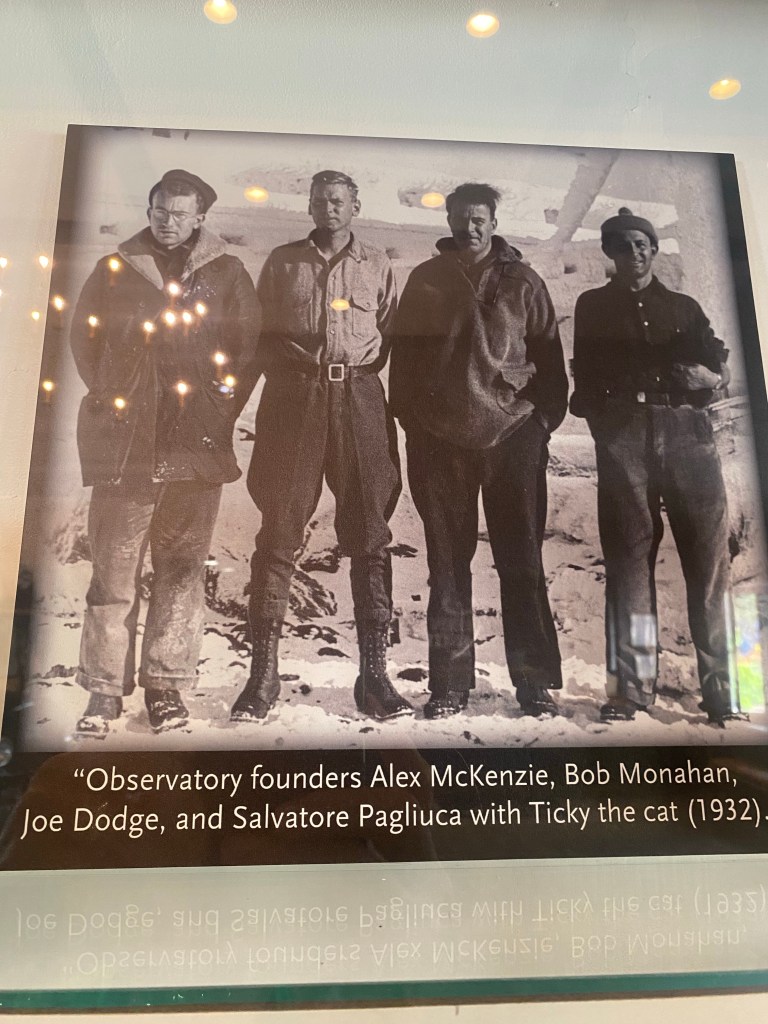
I learned that the observatory was established to study weather and perform climate research in the unusual environment around the mountain, and that it is operated by two alternating crews who live on the summit for a week at a time. Since its founding, the observatory has continuously had a least one resident pet cat, originally to assist in rodent control, but now mainly for companionship and service as the observatory’s mascot. A new cat named Nimbus was adopted in early 2021 after the previous cat, Marty, died after 12 years at the top of the mountain. I apologize for the glare on the glass case that holds the photograph. I asked the motel staff if they could open up the case for me to take a picture, but they said they didn’t have a key for it.
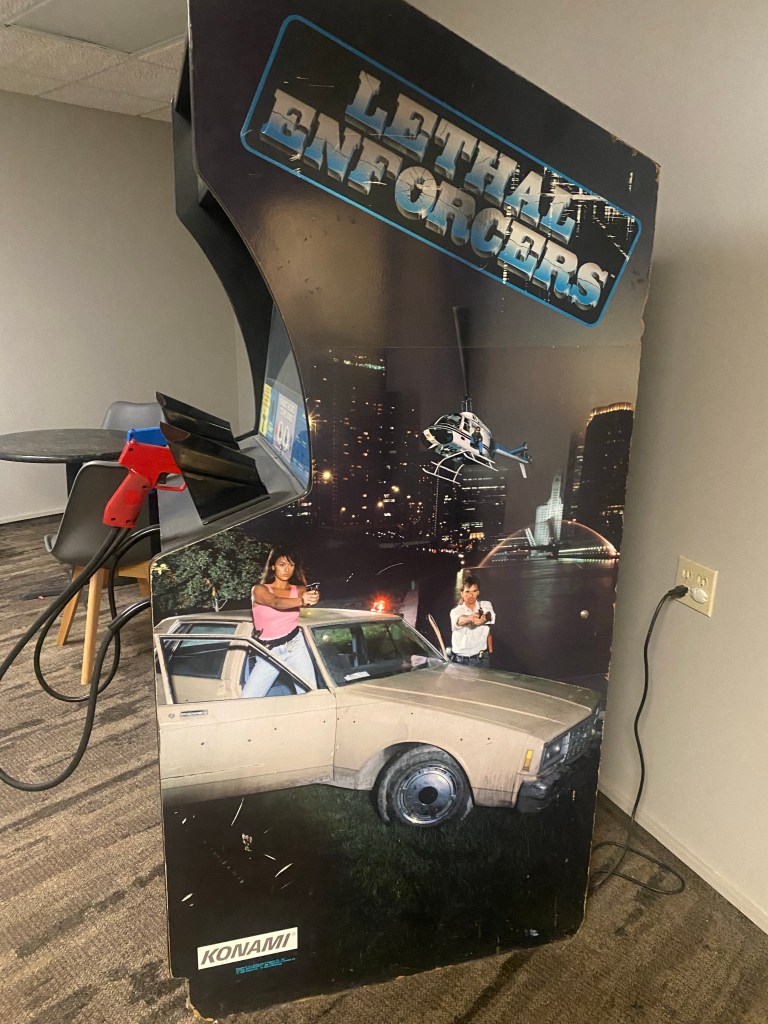
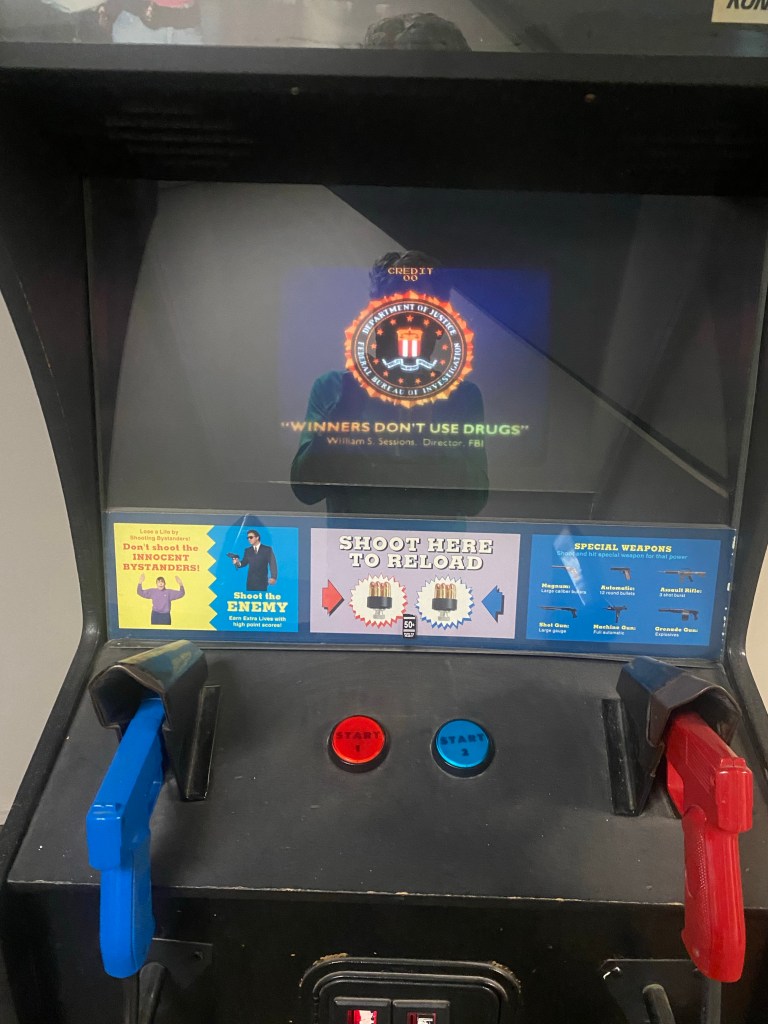
I did some laundry in the motel’s basement this morning, where there is also an old arcade game known as “Lethal Enforcers.” As you can see from the game screen, players can choose weapons ranging from a magnum to an assault rifle and a grenade gun, and they will earn extra lives for shooting the enemy, but will lose a life by shooting innocent bystanders.
I also noticed a prominent legend in the center of the game screen indicating “Winners Don’t Use Drugs. William S. Sessions, Director, FBI.” “What the heck is that about?” I wondered. After a little research, I learned that by law, this legend had to be included in the “attract mode” of North American-released arcade games from 1989 to 2000. Sessions served as Director of the FBI from 1987 to 1993, so I am guessing this game is at least 30 years old. The things you can learn by visiting the laundry in the basement of a motel!
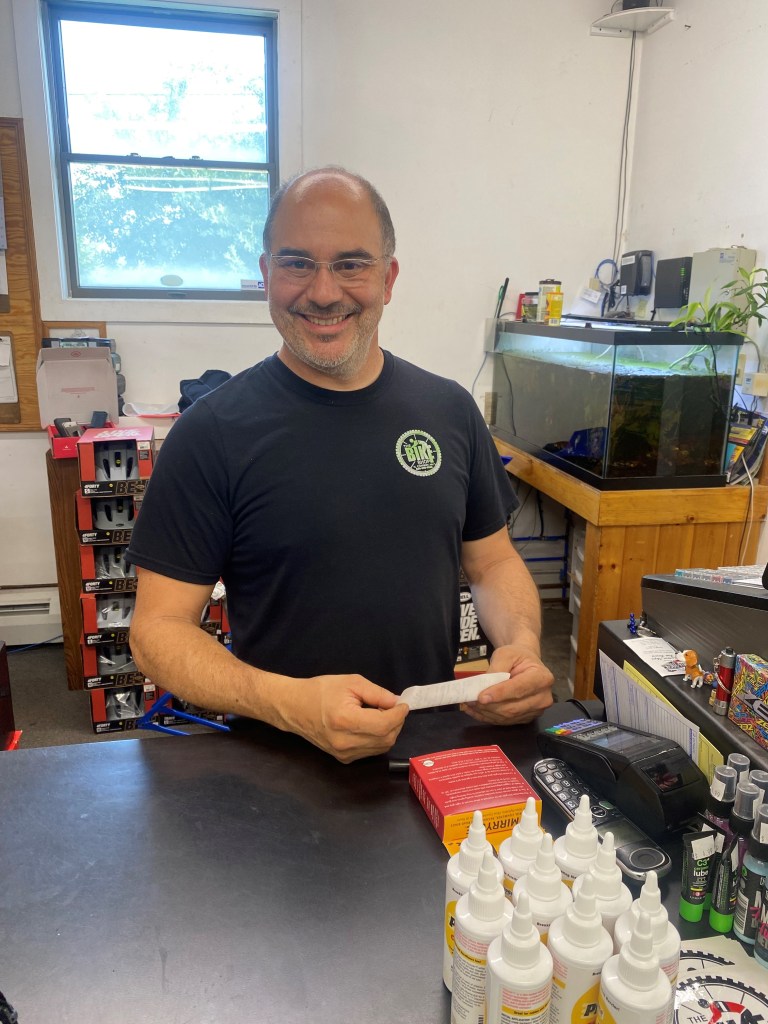
I picked up my bike this afternoon from Anthony at The Bike Shop in North Conway, NH–nice guy. He took the bike in on short notice and made some further adjustments to my derailleur, replaced a malfunctioning mirror, and sold me some replacement rear pannier bags. Now I need to get them packed up for tomorrow’s ride. I hope to get an early start for the Kanc in the morning.
Anthony assures me I will have no trouble riding up the road to the Kancamagus Pass, even with 45 lbs. of gear.


 Joe Green's Bike Adventure
Leave a comment